One of the first questions we get from Meridian homeowners and contractors is whether a dumpster rental requires a permit. The honest, short answer is: it depends entirely on where the container sits, not on the fact that you're renting one at all. Here's how to tell which situation applies to you.
On your own property: no permit needed
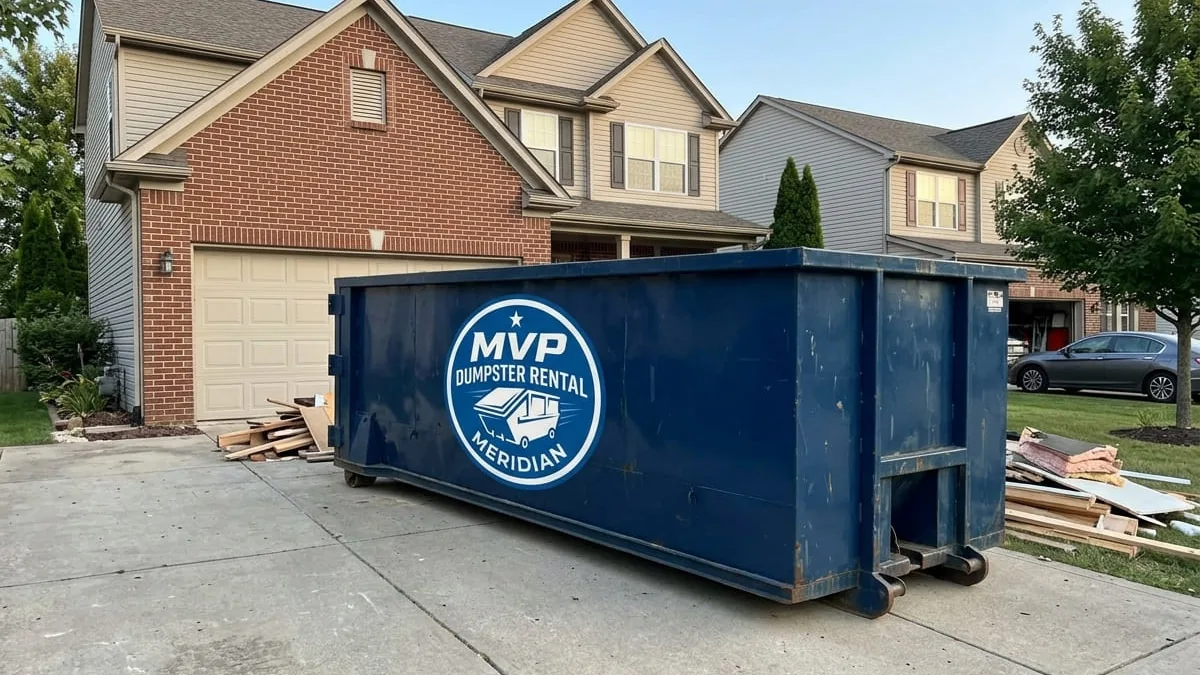
If the dumpster sits entirely on private property — your driveway, your yard, a parking area on your own lot — you generally do not need a permit from the City of Meridian. This covers the large majority of residential rentals we deliver. As long as the container stays off the public street, sidewalk and right-of-way, placement is a matter between you and us: we'll help you figure out where on your property it fits and how to protect the surface underneath it (see our note on driveway protection below).
On the public right-of-way: a permit is typically required
The situation changes if there's no room on your property and the dumpster needs to sit on the street, on the curb, or anywhere else that counts as public right-of-way. Placement in the right-of-way is governed by Chapter 20 (Streets, Sidewalks) of the Meridian Code of Ordinances, and in that situation you'll typically need to secure a permit from the city before the container is placed. This exists for a straightforward reason: anything sitting in the street or blocking a sidewalk affects traffic flow, pedestrian access, and emergency vehicle access, so the city wants to know about it and sign off on the placement.
Because permit and fee requirements can be updated, and this guide is meant as a starting point rather than the final word, always confirm the current fee and application process directly with the city before you plan on right-of-way placement. Don't assume last year's requirement, or a number a friend quoted you, is still accurate.
How to tell which situation you're in
Ask yourself: if I stood at the edge of my property line, would the dumpster be entirely on my side of that line? If yes, you're almost certainly in the no-permit-needed category. If any part of the container would sit on the street, the curb strip, or a public sidewalk, you're in right-of-way territory and should plan on a permit conversation with the city before delivery day.
When you book with us, tell our dispatcher honestly about your available space. If your driveway is short, narrow, blocked by other vehicles, or otherwise can't fit the size you need, we'll talk through the options — a smaller container that fits on-property, adjusting placement, or handling the right-of-way permit conversation together — rather than showing up and discovering a problem on delivery day.
Unincorporated Lauderdale County
If your project is outside Meridian's city limits, in one of the unincorporated communities of Lauderdale County, city ordinance doesn't apply the same way. Right-of-way placement questions for unincorporated areas fall under the authority of the Lauderdale County Board of Supervisors rather than the City of Meridian. If your project is in one of these areas and you're unsure whether right-of-way rules apply to your situation, reaching out to the Board of Supervisors directly is the right move.
What happens if you place a dumpster in the right-of-way without a permit
Placing a container in the public right-of-way without the required permit can result in fines or a requirement to relocate the container, on top of the inconvenience of doing it twice. It's a lot simpler to check ahead of time — a quick call before delivery day avoids the whole situation.
What the permit process generally looks like
Every city's process can differ in the details, but right-of-way permits for temporary placements like a roll-off container typically involve submitting an application to the city, describing the location, size and expected duration of the placement, and paying an associated fee. Processing time varies, so if you already know your project will need right-of-way placement, it's worth starting that conversation with the city before you're up against a tight delivery deadline. We're happy to help you think through the details of what to describe in that application, even though the approval itself has to come from the city.
Contractors and repeat right-of-way placements
If you're a contractor who regularly needs right-of-way placement across multiple Meridian job sites — new construction, larger renovation projects where the driveway is already occupied by equipment — it's worth having a direct conversation with the city about how their permit process works for recurring or overlapping projects, rather than treating each one as a one-off. A little bit of upfront relationship-building with the permitting office tends to make each individual project go more smoothly.
A few practical notes regardless of placement
- Even on your own property, avoid blocking your own driveway entrance in a way that traps other vehicles or makes it hard for our truck to deliver or retrieve the container
- Keep the area around the container reasonably clear so loading is safe and efficient
- If your neighborhood has an HOA, it's worth a quick check on their own placement preferences, separate from city or county rules
The simplest path: ask us first
When you call to book, describe your property and where you're hoping to place the container. We deliver in Meridian and across Lauderdale County regularly and can usually tell you right away whether your situation is a straightforward driveway placement or one that needs a right-of-way permit conversation with the city or county first.